
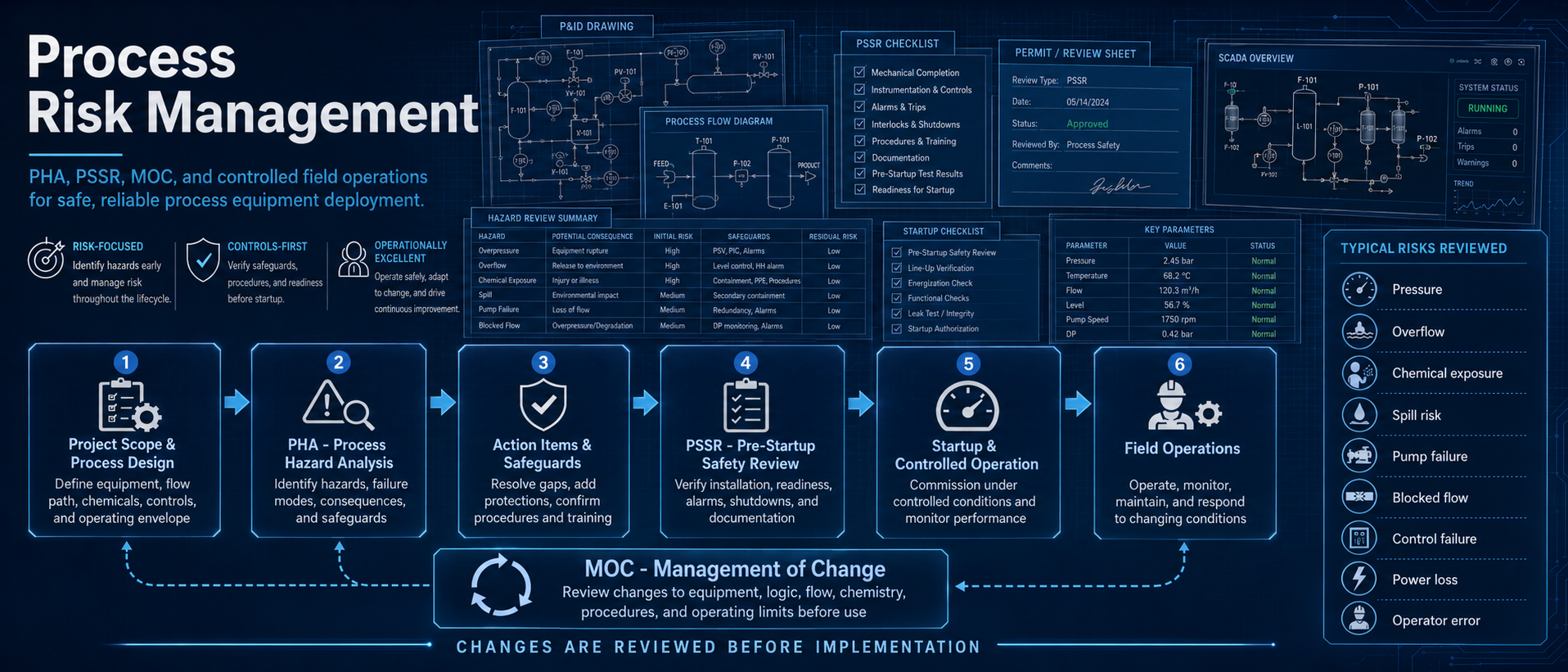
Process Safety Built Into Every Field Job
PHA, PSSR, and MOC for Field-Deployed Process Equipment
At DHI, process safety is not reserved for permanent plants, major facilities, or large capital projects. We apply process safety discipline to field-deployed equipment projects because mobile and temporary systems can carry the same operational risks as fixed infrastructure.
Every field job involving process equipment is reviewed through a practical safety framework built around:
Process Hazard Analysis, PHA
Pre-Startup Safety Review, PSSR
Management of Change, MOC
This approach helps ensure that each job is properly scoped, reviewed, installed, started up, operated, and modified under controlled conditions.
Our Commitment
DHI is committed to applying process safety discipline to every field-deployed process equipment project.
Whether the job involves a single pump package or a complex SCADA-controlled water treatment system, the same principle applies:
Every job must be understood before it is started. Every startup must be verified before operation. Every change must be reviewed before implementation.
That is how DHI delivers field process equipment projects with safety, reliability, and accountability.
Temporary Equipment Still Requires Permanent Discipline
Field-deployed systems are often assembled quickly, in difficult environments, and under changing customer requirements. A water treatment package, transfer pump system, chemical injection skid, tank battery, DAF unit, hose system, or SCADA-controlled process may be temporary, but the hazards are real.
These systems can involve:
Pressure
Flow restriction
Overfill risk
Chemical exposure
Hydrocarbons
H2S exposure
Oil carryover
Solids loading
Pump failure
Power loss
Control failure
Spill potential
Operator error
Environmental exposure
DHI’s position is simple:
A temporary system should never be treated as an informal system.
If equipment is moving fluid, applying pressure, injecting chemicals, separating oil, handling solids, or operating under PLC or SCADA control, it must be reviewed with discipline before operation begins.
Our Standard for Every Job
For every field-deployed process equipment project, DHI applies a structured review process.
1. Scope the Job
Before equipment is mobilized or started, we define the work clearly.
This includes:
What the customer is trying to achieve
What fluid is being handled
What equipment will be used
What the expected flow rates are
What pressures may be created
What chemicals may be required
What tanks, hoses, pumps, and manifolds are involved
What control systems are needed
What alarms, shutdowns, or safeguards are required
What operating limits must be followed
The objective is to understand the system before it is placed in service.
2. Perform a Process Hazard Analysis
DHI reviews the process before startup to identify potential issues.
The PHA considers:
Loss of flow
Blocked discharge
Closed valves
Pump deadhead
Tank overflow
Incorrect valve alignment
Chemical overfeed
Chemical underfeed
Loss of containment
Unexpected oil or solids loading
H2S or vapor exposure
Pressure buildup
Hose or manifold failure
Control system failure
Loss of SCADA communication
Power interruption
Restart after shutdown
Operator misunderstanding
The PHA identifies hazards, consequences, safeguards, and action items required before startup.
The goal is not paperwork. The goal is to make sure the equipment, operating plan, and field team are ready for the real conditions they may face.
3. Close Safety and Readiness Action Items
Before startup, required action items must be addressed.
These may include:
Adding pressure gauges
Installing high-level alarms
Confirming shutdown logic
Revising hose routing
Adding containment
Changing valve placement
Updating operating procedures
Confirming chemical compatibility
Improving access for maintenance
Testing instrumentation
Training operators
Clarifying emergency response steps
Correcting equipment deficiencies
No job should proceed simply because the equipment has arrived on location. The system must be made ready.
4. Complete a Pre-Startup Safety Review
The PSSR is the final readiness gate before operation.
DHI verifies that:
The installed equipment matches the approved setup
The flow path is correct
Pumps, tanks, hoses, valves, and manifolds are properly configured
Pressure ratings are suitable
Chemical systems are correctly installed and labeled
Controls and instrumentation are functioning
SCADA displays are active where required
Alarms and shutdowns have been checked
Operators understand the system
Procedures are available
Emergency response steps are understood
PHA action items are closed or formally approved
The PSSR confirms that the job is not just assembled, but ready to operate safely.
5. Start Up Under Controlled Conditions
Startup is one of the highest-risk points in field operations.
DHI starts process systems in a controlled manner, with attention to:
Initial flow rate
Pressure response
Tank level behavior
Chemical dosing rates
Pump performance
Valve positions
Instrumentation readings
SCADA visibility
Alarm response
Operator communication
Customer interface points
Early signs of instability
The system is closely monitored during initial operation to correct issues before they become incidents.
6. Manage Changes Through MOC
Field conditions change. DHI recognizes that adjustments are sometimes necessary. However, changes must be reviewed before implementation.
Management of Change applies when there are changes to:
Equipment selection
Pump capacity
Hose size or routing
Tank sequence
Valve arrangement
Manifold configuration
Chemical type
Chemical dosing rate
Operating pressure
Flow rate
PLC logic
Alarm settings
Shutdown settings
SCADA screens
Bypass lines
Tie-in pointS
Operating procedures
Staffing or operating responsibility
The purpose of MOC is to prevent uncontrolled field changes from creating new hazards.
Before a material change is made, DHI reviews:
What is changing
Why the change is needed
What new hazards may be created
Whether pressure, flow, chemistry, containment, or controls are affected
Whether procedures must be updated
Whether operators need additional instruction
Whether the PHA must be revised
Whether a new PSSR is required before the restart
This keeps the job under control even as operating conditions evolve.