
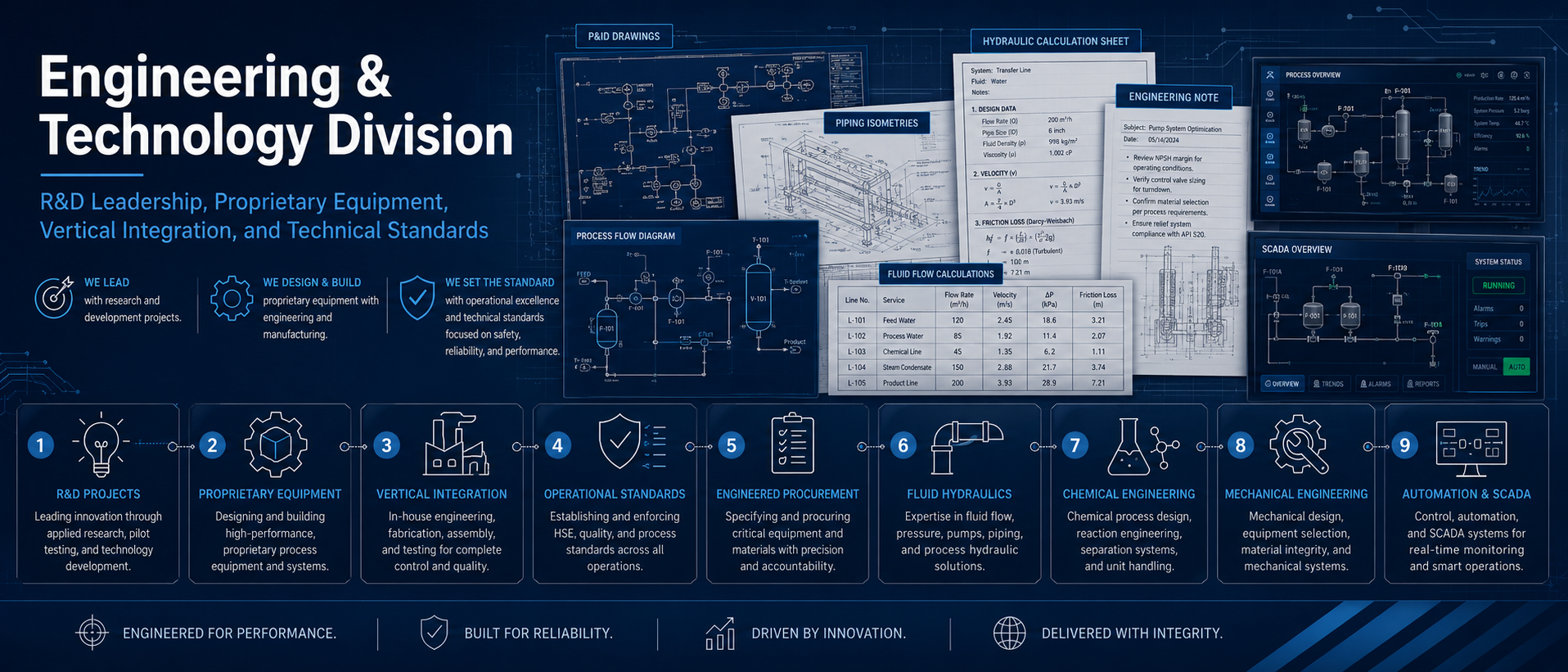
DHI’s Engineering & Technology Division is the technical foundation behind our field-deployed process equipment services.
It leads research and development, supports vertically integrated manufacturing, develops proprietary equipment, strengthens procurement standards, supports fluid hydraulic and chemical engineering needs, provides mechanical design support, integrates automation and SCADA, and helps define the operational standards used across the company.
This division allows DHI to move beyond conventional equipment rental and field service execution. It positions DHI as a technically capable process equipment company with the ability to design, build, deploy, control, and continuously improve the systems it operates.
What the Engineering & Technology Division Does
DHI’s engineering function supports the company across multiple technical disciplines, including:
Research and development
Proprietary equipment design
Vertically integrated manufacturing support
Process equipment improvement
Fluid hydraulics
Chemical engineering support
Mechanical engineering
Process safety and operational standards
Engineered procurement specifications
SCADA and automation integration
Field equipment readiness
Technical documentation
Continuous improvement from field lessons learned
This structure enables DHI to develop practical, field-ready equipment while maintaining technical control over its design, deployment, operation, and improvement.
Chemical Engineering Support
Chemistry, Treatment Performance, and Process Stability
DHI’s Engineering & Technology Division supports the chemical engineering needs of water treatment, oil separation, produced water handling, and chemical injection projects.
This may include review of:
Chemical selection
Dosing rates
Reaction time
Oxidation requirements
Coagulation and flocculation
pH adjustment
Oil and solids separation
H2S treatment considerations
Scaling potential
Chemical compatibility
Retention time
Mixing requirements
Chemical storage and containment
Treatment performance data
Laboratory and field test results
Chemical treatment systems must be understood as process systems, not just chemical feed systems. The wrong chemical, wrong dose, wrong residence time, or wrong injection point can reduce performance, damage equipment, create downstream problems, or increase safety risk.
Engineering helps connect chemistry, equipment, controls, and field execution into one operating plan.
Mechanical Engineering
Practical Design for Harsh Field Conditions
DHI’s mechanical engineering support focuses on equipment that must work in real field environments.
Mechanical engineering needs may include:
Skid design
Tank modifications
Piping layouts
Structural supports
Access platforms
Maintenance access
Equipment mounting
Pump and motor alignment
Lifting and handling points
Trailer or mobile equipment integration
Guarding and personnel protection
Material selection
Corrosion and wear considerations
Fabrication drawings
Design for serviceability
Field equipment must be rugged, maintainable, transportable, and safe to operate. Mechanical design must account for how equipment is lifted, moved, connected, accessed, serviced, cleaned, and repaired in the field.
DHI’s engineering approach is focused on practical durability, not theoretical design alone.
Vertically Integrated Equipment Development
Design, Build, Improve, and Deploy
DHI’s vertically integrated approach allows the company to design and improve proprietary equipment internally rather than relying entirely on off-the-shelf systems.
This gives DHI greater control over:
Equipment layout
Material selection
Fabrication quality
Maintenance access
Field durability
Operating procedures
Instrumentation and control features
Safety systems
Deployment speed
Cost structure
Future improvements
By linking engineering, fabrication, operations, procurement, and field feedback, DHI can continuously improve its equipment designs based on real-world performance.
This creates a practical innovation loop:
Field need identified
Engineering concept developed
Equipment designed or modified
Fabrication and procurement specified
Field deployment reviewed
Performance monitored
Lessons learned fed back into the next design
That loop is central to DHI’s long-term technology strategy.
Engineered Procurement Standards
Buying Equipment the Right Way
DHI’s engineering team supports procurement by defining the technical specifications required for critical equipment purchases.
This helps ensure that purchased equipment is suitable for the intended field application, rather than being selected only on price or availability.
Engineering-supported procurement may include specifications for:
Pumps
Motors
Variable frequency drives
Control panels
PLC components
Instrumentation
Flow meters
Pressure sensors
Level sensors
Valves
Chemical injection pumps
Piping and hose systems
Skid-mounted equipment
Tank components
Electrical enclosures
Structural frames
Safety systems
The goal is to make procurement technical, deliberate, and repeatable.
A pump, panel, valve, sensor, or skid is not just a purchased item. It is part of a larger operating system. Engineering ensures that these components are selected with the right pressure rating, material compatibility, control capability, environmental rating, maintenance access, and integration requirements.
Research and Development Leadership
Turning Field Problems Into Practical Technology
DHI’s Engineering & Technology Division leads the company’s research and development efforts. These projects are focused on solving real field problems, improving operating reliability, reducing customer cost, increasing treatment performance, and building proprietary equipment advantages.
R&D efforts may include:
New water treatment equipment
Improved DAF system designs
Oil separation technology
Chemical injection systems
Sludge handling improvements
Mobile process skids
Tank level monitoring systems
Flow control and valve skids
Pump control systems
Remote monitoring and SCADA integration
Automation and shutdown logic
Improved field deployment methods
DHI’s R&D is grounded in field reality. We do not pursue technology for appearance alone. We develop systems that can survive field use, improve performance, reduce risk, and create a measurable operational advantage.
Proprietary Equipment and Product Development
DHI develops and improves proprietary equipment systems to support its field service lines and customer needs.
These systems may include:
DAF treatment units
Oil separation tanks
Reaction tanks
Chemical injection systems
Pump control packages
Inline flow and valve skids
Filtration systems
Sludge handling packages
SCADA-enabled monitoring systems
Mobile process equipment packages
Custom skids and manifolds
The objective is to create equipment that is not generic, but designed around DHI’s operating experience, service model, customer requirements, and field conditions.
In our opinion, this is one of the most important differentiators for DHI. A company that can design and improve its own equipment is better positioned than a company that can only rent, buy, or imitate standard equipment.
Operational Standards and Technical Governance
Engineering Discipline Applied to Field Execution
The Engineering & Technology Division supports the development and oversight of technical operating standards across DHI’s field equipment projects.
This includes standards for:
Equipment setup
Hydraulic modeling
Pressure control
Flow path design
Chemical injection configuration
Tank sequencing
Instrumentation placement
Pump operation
SCADA and control logic
Pre-startup verification
Process safety reviews
Inspection requirements
Maintenance access
Field documentation
Equipment readiness before mobilization
Engineering helps ensure that field execution is not based on informal judgment alone. It provides the technical backbone for how systems should be designed, reviewed, started up, operated, modified, and improved.
Fluid Hydraulics
Understanding Flow, Pressure, and System Behavior
DHI’s engineering function supports the hydraulic design and review of water transfer, water treatment, pumping, hose, piping, and process equipment systems.
Fluid hydraulics support may include:
Flow rate calculations
Pressure drop analysis
Pump selection
Hose and pipe sizing
Elevation change review
Manifold design
Valve placement
Backpressure evaluation
Deadhead risk review
Cavitation risk review
Tank level behavior
Hydraulic modeling
Startup and shutdown behavior
Pressure protection requirements
This work is especially important in field-deployed systems where long hose runs, elevation changes, temporary manifolds, customer tie-ins, and changing operating conditions can create unexpected pressure and flow behavior.
Hydraulic understanding is essential to safe, reliable field execution.
Automation, Controls, and SCADA Integration
Modern field process equipment increasingly depends on automation, instrumentation, and remote monitoring.
DHI’s engineering team supports the integration of:
PLC control systems
SCADA displays
Remote monitoring
Tank level systems
Pressure monitoring
Flow meters
Alarm logic
Shutdown logic
Pump control
Valve control
Chemical injection control
Data logging
Operator interface screens
Customer reporting data
Automation is not simply an add-on. It must be integrated into the process design, operating philosophy, and safety review.
The engineering team helps ensure that field controls are understandable, testable, maintainable, and aligned with the way the system actually operates.
Supporting Process Safety
The Engineering & Technology Division supports DHI’s process safety practices, including:
Process Hazard Analysis, PHA
Pre-Startup Safety Review, PSSR
Management of Change, MOC
Equipment readiness reviews
Operating envelope definition
Safeguard identification
Control logic verification
Technical action item resolution
Post-job lessons learned
Engineering plays a critical role in making sure technical risks are identified before startup and that changes are reviewed before implementation.
This is especially important for temporary and mobile process systems where equipment is often assembled, modified, and operated under changing field conditions.